

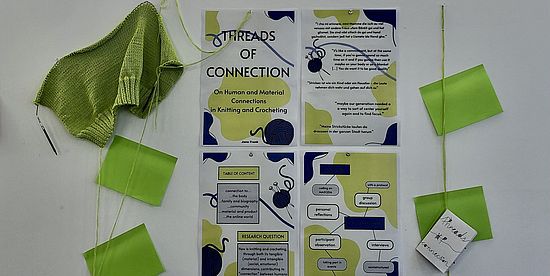
Jana FrankThreads of Connection - A research report on human connections through knitting and crocheting
“Knitting in public is like having a dog or a child – people notice you and come up to you” one interlocutor said to me when I was in the phase of data collection for the fieldtrip course of anthropology. As a knitter myself, I knew what they meant. Knitting in public for me had also created all sorts of interactions. However, during the field trip, I noticed how knitting was much more than a possibility to create fleeting connections between strangers.
Choosing a topic for the field trip in the first place was the hardest part for me. My final choice – knitting as a form of connection – occurred out of a little desperation: I was going through a tough time in my personal life, and all I wanted to do was something that I enjoyed, something that relaxed me and something that I knew I was going to be doing anyways during the semester break. My final work ended up exploring and finding a variety of ways in which knitting and crocheting shape both one’s own experiences and connections between humans. On the intrapersonal level, the report explored how knitting and crocheting are closely tied to individual biography, mental health, grief management, gender roles, and leisure practices. Activities like knitting and crocheting are not merely skills but practices that shape a person’s sense of self, emotional well-being and can provide relief in situations of stress. One interview participant said: “you can see your progress and sometimes this like really small, even mindless way to make progress, it helps me to ground myself. Even if I don't feel (like) I'm making a difference in other things that I'm doing this is very obviously a step forward.” Like in this quote, many interlocutors agreed that knitting was connected to their own mental health.
On the interpersonal level, the research project showed how knitting and crocheting can be tools that initiate and strengthen relationships. Handmade gifts, intergenerational practices, and shared activities are examples of how knitting and crocheting serve as practices of human connection. In public spaces and digital communities alike, knitting and crocheting create interaction, bridging the gap between strangers or reinforcing bonds within social groups. One important aspect of the interpersonal interaction created by knitting for me personally was highlighted by the interview with my grandmother who taught me how to knit when I was a child. Talking to her, I realized that knitting together or talking about it was a central part of our relationship, even though our access to knitting had been so different. To me, it has always been a hobby, while she saw it as a necessity to make clothes for her family before it became her hobby. Still, it is something we bond over and which creates our connection.
To come back to the beginning: Not all interlocutors agreed that knitting was something like having a child or a dog, something that built bridges between strangers in public. For some it is a private hobby, happening only in their four walls: More than anything, the research showed me that there are diverse personal stories behind knitting and crocheting and that people make individual experiences with and around knitting and crocheting. But I also found in my research that knitting and crocheting should not only be understood as individual hobbies and a contemporary trend but as practices that weave together identity and community. Far from a closed subject, this research points to a wider field of possible research where issues of activism, sustainability, social change and intersectional feminism in relation to knitting and crocheting remain to be explored.
Author Bio:
Jana Frank started her masters in Changing societies in 2023. She completed a BA in History and English Literature and Linguistics from the University of Basel and attended a few semesters in Psychology. Next to her studies, she works as a project manager in health literacy and health equity.
Context:
The report was written during the two-semester ethnographic fieldwork for the course “Young Swiss Diaspora” in the autumn term 2024/spring term 2025. The conducted research data included transcripts of two interviews, a protocol of a focus group as well as notes from participant observations. The focus group was organized around all participants bringing their current knitting project along and continuing to work on it while discussing the questions. This method contributed to a relaxed atmosphere and brought the topic of the discussion directly to the center of the table.
Quick Links
Social Media