

Contents and Modules
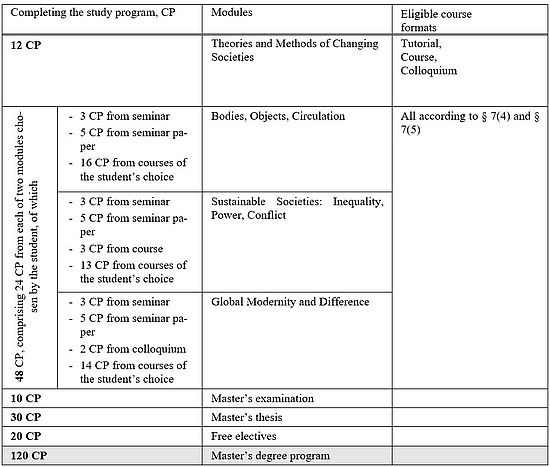
The Changing Societies master’s degree program consists of the foundational module "Theories and Methods of Changing Societies” (12 CP) and the three thematic modules “Bodies, Objects, Circulation” (24 CP), “Sustainable Societies: Inequality, Power, Conflict” (24 CP), and “Global Modernity and Difference” (24 CP).
To complete the program, students must select two of the three thematic modules. A seminar paper must be written in each of the two selected modules.
The program underwent a fundamental reform in the fall semester of 2026. For information on the content under the old curriculum, please click here.
Theories and Methods of Changing Societies
The foundational module “Theories and Methods of Changing Societies” consists of the courses Fundamentals of Qualitative Research and Fundamentals of Quantitative Research, as well as the Theory Colloquium. The two methods courses provide students with basic knowledge of qualitative and quantitative social research and foster research-oriented reflection on theoretical perspectives and concepts. In the theory colloquium, students are guided in discussing and reflecting on theoretical perspectives and concepts relating to changing societies. It is recommended that students complete the methods training (course plus tutorial in qualitative and quantitative research) during the first year of study and attend the theory colloquium in the second year while preparing their Master’s thesis.
Module "Bodies, Objects, Circulation"
This module introduces students to key social science approaches for understanding bodies and objects as powerful political and social entities. Drawing on anthropology, feminist and queer theories, theories of materiality, and science and technology studies, it examines how bodies and objects emerge through their relationships with images and infrastructures within systems of capital and control. Topics include migration and displacement, global tourism, humanitarian interventions, commodity and popular cultures, as well as museum and heritage politics. Students also examine how objects—from consumer goods to technical and cultural artifacts, from living beings and inert matter to technological and epistemic instruments—mediate relationships between individuals, states, markets, and institutions. Throughout the module, particular attention is paid to how ideas, capital, and practices of governance, such as surveillance and militarization, circulate both globally and locally. The courses in this module provide a clear conceptual and methodological foundation for critically engaging with mobility, materialization, and power, preparing students to analyze contemporary societal issues in an interconnected world.
Module "Sustainable Societies: Inequality, Power, Conflict"
This module offers courses focusing on inequality, resources, and conflict. The courses introduce students to theories and approaches from political science, international relations, and sustainability studies. They also provide intensive engagement with, and application of, empirical methods in the social sciences. The module focuses on questions of political and social inequality, political representation, the functioning of political institutions, as well as intra- and interstate conflicts and peacebuilding. In addition, the courses address issues related to the fair distribution of resources, sustainable political and economic processes, and the consequences of climate change. The module combines an introduction to fundamental theoretical approaches with insights into current research in these thematic areas.
Module "Global Modernity and Difference"
This module examines the global dimensions of modernity, with a particular focus on the interplay between integration and difference. It introduces students to key theories of modernity and modernization, as well as their critiques and recent developments. The module addresses both historical and contemporary processes of social differentiation and de-differentiation, different paths of modernization in Western and non-Western contexts, and the significance of culture, gender, class, and ethnicity for the structuring of global inequalities. Students engage with theoretical approaches and empirical case studies in order to understand global transformation processes. The aim is to highlight the global diversity of manifestations of modernity and to critically reflect on how modernity and difference are intertwined. The module also discusses global power relations and their influence on knowledge production and collective identities. It fosters students’ ability to analytically assess complex social dynamics and evaluate them from a normative perspective.
Further information on the structure of the program and all modules can be found in the degree program guidelines.
The study program provides an overview of the program structure and structure of the degree programs:
Quick Links
Social Media