


Attention: The program was reformed for the fall semester 2026. This page provides an overview of the program content according to the previous study regulations. For information on the current program structure, please click here.
Students who are already enrolled may complete their studies under the previously applicable regulations during a transitional period. To do so, however, they must complete their studies by 31 January 2029 at the latest. Students completing their studies after this date must transfer to the revised study plan. Upon request, students who are already enrolled may transfer to the Master’s program Changing Societies under the revised study plan from the fall semester 2026 onwards.
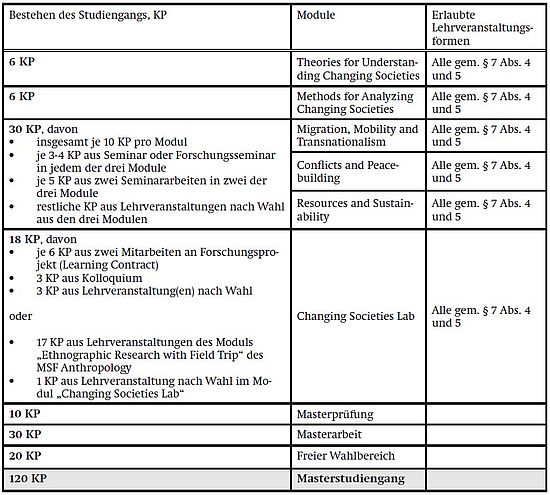
The master's degree program Changing Societies: Migration - Conflicts - Resources includes the six modules "Theories for Understanding Changing Societies" (6 CP), "Methods for Analyzing Changing Societies" (6 CP), "Migration, Mobility and Transnationalism" (10 CP), "Conflicts and Peacebuilding" (10 CP), "Resources and Sustainability" (10 CP) and "Changing Societies Lab" (18 CP). To pass the degree program, a seminar paper must be written in two of the three modules "Migration, Mobility and Transnationalism", "Conflicts and Peacebuilding" and "Resources and Sustainability".
Module "Theories for Analyzing Changing Societies"
The courses in this module provide an overview of the various theoretical foundations for understanding and analyzing “changing societies.” They introduce theories that seek to explain society, culture, and politics from both historical and contemporary perspectives, as well as selected areas of social, political, and cultural processes. The courses address developments at the local, regional, national, and international levels and discuss structural and institutional approaches as well as process-oriented and actor-centered perspectives.
Module "Methods for Analyzing Changing Societies"
The courses in this module provide the methodological foundations for empirical work on the subject of “changing societies.” Students select from the Department’s regularly offered basic courses in qualitative and quantitative research methods those courses that provide them with the methodological tools required for participation in a Changing Societies Lab. The individual participating research groups define the relevant requirements, which are summarized for students in an information sheet. This module also provides the foundations needed for writing a research-oriented Master’s thesis. The basic course offerings are occasionally complemented by specific, specialized methods courses.
Module "Migration, Mobility and Transnationalism"
This module offers courses focusing on the thematic area of “migration and mobility.” The courses introduce students to theories and approaches in migration and mobility research, provide an overview of historical developments and current processes of migration through various examples, and lay the foundations for understanding the national and international frameworks of migration policy. They also address broader questions relating to interconnected and transnational societies. Students must attend at least one seminar or research seminar in this module.
Module "Conflicts and Peacebuilding"
This module offers courses focusing on the thematic area of conflict and peace research. In addition to introducing general theories, the module addresses topics such as global governance, mediation, statehood and democracy, the role of economic actors in conflict contexts, and transitional justice. The interplay between academic research and practice is also examined through concrete examples. Students must attend at least one seminar or research seminar in this module.
Module "Resources and Sustainability"
This module offers courses focusing on the thematic area of “resources and sustainable development.” Key topics include societal approaches to resources, such as inequalities in access to and control over resources; the transformation of consumer society; changing expectations regarding quality of life; the significance and role of the UN Sustainable Development Goals for societal transformation; different cultural understandings of sustainability; and the opportunities and risks of digitalization for the sustainable development of societies. Students must attend at least one seminar or research seminar in this module.
Module "Changing Societies Lab"
The Changing Societies Lab module can be completed in two different ways:
a) Participation in research projects: Students have the opportunity to participate in ongoing research projects within the disciplines involved in the degree program. This participation corresponds to 6 CP. The details are agreed upon with the respective project supervisors or assessors in a Learning Contract. To successfully complete the module, students must participate in two research projects. In addition, they attend one colloquium (3 CP) and elective courses offered within this module (3 CP).
b) Field research MSF Anthropology: Students attend courses offered by the Anthropology section in connection with the MSF Anthropology. This includes a preparatory course in the fall semester (10 CP), several weeks of field research during the lecture-free period between the fall and spring semesters (January/February), and a follow-up course in the spring semester (5 CP). The topic and aim of the field research are newly defined each year by the academic unit offering the courses. Students attend the colloquium offered within the MSF Anthropology. In addition, they attend one elective course in this module worth at least 1 CP.
The study program provides an overview of the program structure and structure of the degree programs:
Quick Links
Social Media