

/ News, Research
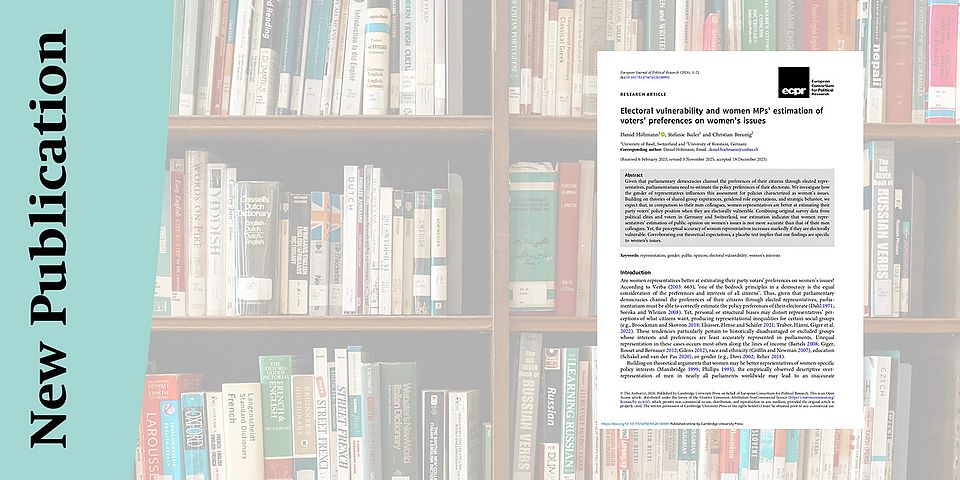
New Publication: Do women MPs really know what voters want on women's issues?
A common assumption in political science — and in everyday political talk — is that women politicians are naturally better at knowing what voters want on women's issues.
They share life experiences with women voters, the argument goes, so they should have a sharper sense of what the public thinks about parental leave, workplace discrimination, or gender equality policies.
A new article in the European Journal of Political Research by Daniel Höhmann, Stefanie Bailer (University of Basel), and Christian Breunig (University of Konstanz) puts this assumption to the test — and finds that the story is more interesting than the textbook version.
The setup
Drawing on the cross-national POLPOP project, the authors fielded parallel surveys of MPs and citizens in Germany and Switzerland. Politicians were asked to estimate what their own party’s voters thought about a series of policy proposals, including several women’s issues. Comparing those estimates to actual citizen opinion gave the researchers a direct, behavioral measure of perceptual accuracy: how well does each MP read their electorate?
The finding
On average, women MPs are not better than their men colleagues at estimating party voters' preferences on women's issues. Shared group experience, on its own, does not produce sharper perceptions.
But add electoral vulnerability into the mix and the picture changes. When women MPs are uncertain about re-election, their accuracy on women's issues jumps — markedly outperforming men in the same situation. Safe seats erase the gap; competitive ones reveal it. A placebo test seals the argument: the effect is specific to women's issues. On unrelated policy areas, no such gendered pattern emerges.
Why it matters
Simply having more women in parliament isn't enough. Even women MPs who don't personally prioritize gender equality feel pressure to stay informed about women's issues — because voters expect them to, and failing to meet those expectations can cost them votes. Men, meanwhile, get credit for engaging with women's issues but aren't penalized for ignoring them. Representation, in other words, is shaped not only by who is in the room, but by the gendered expectations that decide who pays a price for falling short.
Quick Links
Social Media